by Ben Small

Let's get some facts straight about pistols, if you're considering one for home defense.
First, let's talk about accuracy. Face it, pistols aren't accurate much beyond seven yards. And even then, unless you've practiced often and are familiar with your gun, you're likely to tug on the trigger and flinch. If you're right-handed, a tug and flinch trigger-pull will send your bullet to the left of your target. You'll probably miss what you're shooting at all together. So where did your bullet go?
In just about every cop television show or movie, somebody's pulling a trigger. Most people think cops are good shots. Bhwhahaha! Not. In fact, most cops are lousy shots, and they shoot more often than you do. In 2008, the Rand Corporation conducted a study of New York City cop shootings, review processes and training. In doing so, they looked at, among other things, NYC cop shootings from 1998-2006, both where nobody was shooting back and where there was a gunfight. Rand Corporation NYC Cop Shooting Report On page 42 of that report they state that the average gunfight involved 11.1 shots fired, and a hit-rate of 18%. At distances of seven yards or less, the hit rate leaped to a whopping 37%.
Wow! Guess if you hear gunfire you'd be smart to duck.
Barrel length influences accuracy, as do the type of sights used and trigger pull. Of course, if it's dark and you can't see your pistol's sights -- night sights only help in low-light situations, and they glow less bright over time -- barrel length and sights won't help your aim much. And most home invasions occur at night. So you may not know where your barrel is pointing.
Snub nose revolvers, like the one pictured above, are notorious for inaccuracy, even during daylight hours. The reason: a short sight line along the barrel. The same goes for so-called pocket pistols, like the Baby Glock, the Model 26, pictured below.

NYC cops are issued Glocks with a longer barrel length, usually the Model 22, pictured below. Note the longer barrel length.

But NYC cops have an excuse for their lousy shooting. Actually, a few excuses. The standard Glock leaves the factory with a trigger pull weight between five and five and a half pounds. But this trigger pull weight is adjusted to twelve pounds before their pistols are issued. The purpose of the increase is to reduce the number of unintended discharges. But the increased trigger weight means more tugging to fire; hence, less accuracy.
Another excuse relates to the gun-unfriendly laws of New York. There aren't many ranges, so cops don't get to practice much. Yet, most of you won't practice much either, and at least cops have their accuracy checked once in a while; they must qualify periodically.
Sure, you can adjust your trigger weight to lighten the pull. But then if you ever have to actually shoot someone, the prosecutor and your victim's civil lawyer will both accuse you of being "trigger happy" because you installed a "hair-trigger." So, if you are going to use a pistol for home defense, your best bet is to leave trigger weight as it came from the manufacturer. Adjust trigger weight only on guns to be fired exclusively at the range.
So, do you opt for a still longer barrel, like on the Glock 34 and 17L, both shown below?
 |
| Glock 34 |
 |
| Glock 17L |
You betcha! These are Glock's 9mm competition pistols, designed to be their most accurate. Besides, this is a home defense gun you're selecting; you're not going to carry it. And don't you want accuracy in home defense? If not, you may be shooting bystanders, your dog, or depending upon bullet and caliber chosen, your neighbor. But note: Glock barrels are treated with a formulation that can be scraped off by cleaning with a brass brush. So if you go Glock, only clean your gun with nylon brushes. And also note: Don't shoot soft lead bullets from a Glock. Glock barrels don't have the standard land and groove pattern of other pistols, and lead will clog them, resulting in less accuracy. I wonder how many NYC cops are aware of these two Glock peculiarities? So, if you're going to shoot lead bullets from a Glock, make sure your bullets are at least semi-jacketed (where the lead is covered at least partially by a copper jacket).
And since we're talking about accuracy, let's consider the choice between revolvers and semi-auto pistols. Revolvers are considered by many -- not by all gun experts -- to be slightly more accurate than semi-autos. The reason is the barrel is directly in line with the cylinder. In a semi-auto, the pistol is fed by a magazine below the chamber, and a spring in the magazine pushes the bullet up and along a ramp into the chamber. More functions to perform in which the bullet may be slightly mis-aligned. But I don't put much stock into this explanation, because most modern semi-autos have tight chambers. Rather, I think the real reason for a revolver preference among some is either reliability or just personal preference. Yes, semi-autos can jam, and a revolver will always go bang if there's a bullet in the cylinder aligned with the barrel. But revolvers can fail, too. Damage the extractor rod on the muzzle end of the cylinder or the crane, a small sprocket on the butt end of the cylinder, and see if a revolver shoots. How do you damage the crane? Try flipping the cylinder back like you see in the movies. Trust me: I did this on my grandfather's Smith & Wesson, and it cost me a bundle to fix. While a semi-auto may jam, it's easily cleared. Break the crane on your revolver, and you're done.
It's claimed a revolver requires less maintenance than a semi-auto, because there are fewer parts. But Glocks are famous for being abused, and they seem always to go bang. I've seen videos and television shows where Glocks were rusted up, tossed into sand, thrown into lakes and run over by trucks, and the pistols still chamber and fire.
Plus, semi-autos have more capacity than revolvers. Again, notice the statistic above of shots fired in a gun fight. A revolver holds five-to-seven shots, depending upon model, and reloading takes a while even with a stripper clip. A semi-auto mag holds more rounds, up to thirty-three with some Glocks.
Bottom line: Choose whatever suits you.
But grip and stance will affect your accuracy, too. The pistol that fits a spouse may not fit you. A bad grip will result in bad trigger pull. Your shots will go awry. With a semi-auto, you want to grip the pistol with two hands, with your support hand in front of your shooting hand. With a revolver, that grip will burn your hand, because hot gases will shoot out of the cylinder. With a revolver, your support hand should be underneath your firing hand.
Stance: Most range shooters and cops are taught to use either an Isosceles or a Weaver stance, sometimes, a slight modification to one of them. Both are pictured below.
 |
| Isosceles Stance |
 |
| Weaver Stance |
The problem is, in a real life situation like a home invasion at night, you may have to do the best you can. There's another stance approaching more a real life scenario. Point stance. Align your finger with your eye and pull a fake trigger. One handed. That's a stance you may want to practice. Close up, it will work. Some pistols are claimed to "point" better than others. Sig Sauers for instance. You may find you shoot Sigs better in this stance than Glocks, for instance.
Notice also that in both the Isosceles and Weaver stances, you're offering a better target, full on so to speak, to the bad guy. He may be shooting back. More reasons to go to the range: Practice various stances. You may need one some time.
Caliber
During the first Obama-scare, .380s were hard to find. Seemed everybody wanted one. And if you could find one, you couldn't find ammo for it. Now, you may notice gun stores are full of them, but few people are buying them. Personally, I think .380s are mostly useless; they're back up to a back up at best. A .380 bullet may not even penetrate a heavy leather jacket. Okay, the bad guy may die of blood loss eventually, but he'll have more than enough time to kill you.
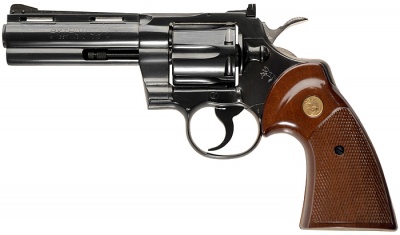
I don't think any caliber less than a .38 Special is adequate for home defense or self-protection, unless as a back-up. The cardinal rule of a gun fight is to have a gun, yes. But in self-protection, you want more gun. But beware: Shoot a magnum round indoors in a closed room and you'll never hear again. Magnums are cannons that should only be fired outside and while wearing hearing protection. You may be deaf for an hour shooting a 9mm, a .40 S&W or even a .45 acp, but it'll likely be temporary. Shoot a magnum, and it's permanent. That's why I do not recommend a .357 magnum or a .44 magnum for home protection. If you have one, like this gorgeous Python below, use .38 Special rounds (or for the .44 magnum, the .44 Special). The rounds will work in these guns.
Be concerned about over-penetration and under-penetration. With the former, your bullets go through bad guys and people and walls behind them; with the latter, your bullets don't penetrate skin. Use hollow-point bullets, or jacketed hollow point rounds, so your bullets fragment and don't go through as many walls. Fully jacketed rounds will over-penetrate, go through your target and anybody or anything behind them, perhaps deflecting into unknown and unpredictable directions. Fully jacketed rounds are considered target or range rounds. Don't use them in your home defense gun, except at the range.
But a non-jacketed hollow point fired out of a short barreled pistol, may clog with heavy cloth such as a winter jacket and not pass through to the bad guy's organs. The Shooting Sports and Ammunition Institute (SAAMI) has standardized bullet specifications. Manufacturers make ammo to these specs, and they also make ammo that exceeds SAAMI specs. Most manufacturers make Home Defense loads that tend to be jacketed hollow point +P rated, meaning these rounds exceed SAAMI specs by one level. +P+ rounds are scarier still, and using +P+ rounds on guns not rated for them may blow up your gun. Most pistol manufacturers state in their small print that using +P+ rounds will void their warranty. And if you use +P+ rounds on a bad guy, or if you roll you own so to speak, expect both a prosecutor and a civil lawyer to claim you were eager to kill...and overkill.
And be aware of a peculiarity. In tests against ballistic jello formulated to match characteristics similar to the human body, a 9mm full jacketed bullet exceeded a .45 acp bullet in penetration. Again, think about where your bullet will go.
 |
| ballistic gel comparison |

Man-stopping rounds are the .357 Magnum, the .40 S&W, the .45acp and larger. The 9mm, not so much. Those who like the 9mm argue capacity (number of rounds available), cheaper practice rounds and less recoil, important for follow-up shots and the flinch factor. Those who don't like 9mm rounds argue that the bad guy may not go down. They use the famous April 11, 1986 FBI disaster, when the 9mm toting Feebs were out gunned by bad guys, an instance that led to the development of the 10mm round and its offspring the .40 S&W cartridge (when the 10mm proved to be too powerful), as proof. And they've got a point. But the 9mm cartridge has a strong following, and I'm one of them. But for home defense, I use a .40 S&W; it's got a little more man-stopping oomph.
What Gun to Buy?
My first response is a shotgun, but we're talking pistols here. Damn! Somebody keep me on target.
The pistols I've referred to here mostly are Glocks. And there are some reasons for that. They work, for one, no matter what you do or don't do to them. Second, they're cheap. If you ever have to use your gun, you'll never see it again, at least not in any shape you'd want it. Cops don't treat evidence guns well. Neither do plaintiff's attorneys. Plus, Glocks come in any caliber or size you'd want. Yes, they're ugly as hell, but they work, they're cheap and a Glock is a Glock: they're damn near indestructible.
.jpg) |
| Sig Sauer P220 |
For feel, I love a Sig Sauer. They seem to fit a hand like a glove. And they point well. But unless you buy a plastic one -- models I happen to love -- they'll cost you about double the price of a Glock. If you want a German engineering masterpiece, albeit at a hefty price, buy a Heckler & Koch. Smith & Wesson makes numerous models, too, both in revolver and semi-auto flavors. And Springfield has a new XDm line, which is receiving rave reviews. They too offer different calibers and sizes. And, of course, the old timer, the 1911, which usually comes in either 9mm or .45 acp.
 |
| 1911 by Nighthawk Custom |
I choose a Glock 35, their competition model in .40 S&W, and I have mine fitted with night sights. (I also have a shotgun.)
But what you should do is choose your own pistol. Go to a gun range that offers rentals and try several. Get one that fits you and that you shoot well. And get it at least in .38 Special. Then buy some Home Defense jacketed hollow point bullets. But above all, practice, practice, practice. It's not just fun to shoot; it's an investment in your family's future.

