Showing posts with label Ben Small. Show all posts

Saturday, May 19, 2012

Home Defense, Part 3 -- The Pistol


by Ben Small


Let's get some facts straight about pistols, if you're considering one for home defense.

First, let's talk about accuracy. Face it, pistols aren't accurate much beyond seven yards. And even then, unless you've practiced often and are familiar with your gun, you're likely to tug on the trigger and flinch. If you're right-handed, a tug and flinch trigger-pull will send your bullet to the left of your target. You'll probably miss what you're shooting at all together. So where did your bullet go?

In just about every cop television show or movie, somebody's pulling a trigger. Most people think cops are good shots. Bhwhahaha! Not. In fact, most cops are lousy shots, and they shoot more often than you do. In 2008, the Rand Corporation conducted a study of New York City cop shootings, review processes and training. In doing so, they looked at, among other things, NYC cop shootings from 1998-2006, both where nobody was shooting back and where there was a gunfight. Rand Corporation NYC Cop Shooting Report On page 42 of that report they state that the average gunfight involved 11.1 shots fired, and a hit-rate of 18%. At distances of seven yards or less, the hit rate leaped to a whopping 37%.

Wow! Guess if you hear gunfire you'd be smart to duck.

Barrel length influences accuracy, as do the type of sights used and trigger pull. Of course, if it's dark and you can't see your pistol's sights -- night sights only help in low-light situations, and they glow less bright over time -- barrel length and sights won't help your aim much. And most home invasions occur at night. So you may not know where your barrel is pointing.

Snub nose revolvers, like the one pictured above, are notorious for inaccuracy, even during daylight hours. The reason: a short sight line along the barrel. The same goes for so-called pocket pistols, like the Baby Glock, the Model 26, pictured below.


NYC cops are issued Glocks with a longer barrel length, usually the Model 22, pictured below. Note the longer barrel length.


But NYC cops have an excuse for their lousy shooting. Actually, a few excuses. The standard Glock leaves the factory with a trigger pull weight between five and five and a half pounds. But this trigger pull weight is adjusted to twelve pounds before their pistols are issued. The purpose of the increase is to reduce the number of unintended discharges. But the increased trigger weight means more tugging to fire; hence, less accuracy. 

Another excuse relates to the gun-unfriendly laws of New York. There aren't many ranges, so cops don't get to practice much. Yet, most of you won't practice much either, and at least cops have their accuracy checked once in a while; they must qualify periodically. 

Sure, you can adjust your trigger weight to lighten the pull. But then if you ever have to actually shoot someone, the prosecutor and your victim's civil lawyer will both accuse you of being "trigger happy" because you installed a "hair-trigger." So, if you are going to use a pistol for home defense, your best bet is to leave trigger weight as it came from the manufacturer. Adjust trigger weight only on guns to be fired exclusively at the range.

So, do you opt for a still longer barrel, like on the Glock 34 and 17L, both shown below?

Glock 34
Glock 17L
You betcha! These are Glock's 9mm competition pistols, designed to be their most accurate. Besides, this is a home defense gun you're selecting; you're not going to carry it. And don't you want accuracy in home defense? If not, you may be shooting bystanders, your dog, or depending upon bullet and caliber chosen, your neighbor. But note: Glock barrels are treated with a formulation that can be scraped off by cleaning with a brass brush. So if you go Glock, only clean your gun with nylon brushes. And also note: Don't shoot soft lead bullets from a Glock. Glock barrels don't have the standard land and groove pattern of other pistols, and lead will clog them, resulting in less accuracy. I wonder how many NYC cops are aware of these two Glock peculiarities? So, if you're going to shoot lead bullets from a Glock, make sure your bullets are at least semi-jacketed (where the lead is covered at least partially by a copper jacket).

And since we're talking about accuracy, let's consider the choice between revolvers and semi-auto pistols. Revolvers are considered by many -- not by all gun experts -- to be slightly more accurate than semi-autos. The reason is the barrel is directly in line with the cylinder. In a semi-auto, the pistol is fed by a magazine below the chamber, and a spring in the magazine pushes the bullet up and along a ramp into the chamber. More functions to perform in which the bullet may be slightly mis-aligned. But I don't put much stock into this explanation, because most modern semi-autos have tight chambers. Rather, I think the real reason for a revolver preference among some is either reliability or just personal preference. Yes, semi-autos can jam, and a revolver will always go bang if there's a bullet in the cylinder aligned with the barrel. But revolvers can fail, too. Damage the extractor rod on the muzzle end of the cylinder or the crane, a small sprocket on the butt end of the cylinder, and see if a revolver shoots. How do you damage the crane? Try flipping the cylinder back like you see in the movies. Trust me: I did this on my grandfather's Smith & Wesson, and it cost me a bundle to fix. While a semi-auto may jam, it's easily cleared. Break the crane on your revolver, and you're done.

It's claimed a revolver requires less maintenance than a semi-auto, because there are fewer parts. But Glocks are famous for being abused, and they seem always to go bang. I've seen videos and television shows where Glocks were rusted up, tossed into sand, thrown into lakes and run over by trucks, and the pistols still chamber and fire.

Plus, semi-autos have more capacity than revolvers. Again, notice the statistic above of shots fired in a gun fight. A revolver holds five-to-seven shots, depending upon model, and reloading takes a while even with a stripper clip. A semi-auto mag holds more rounds, up to thirty-three with some Glocks.

Bottom line: Choose whatever suits you.

But grip and stance will affect your accuracy, too. The pistol that fits a spouse may not fit you. A bad grip will result in bad trigger pull. Your shots will go awry. With a semi-auto, you want to grip the pistol with two hands, with your support hand in front of your shooting hand. With a revolver, that grip will burn your hand, because hot gases will shoot out of the cylinder. With a revolver, your support hand should be underneath your firing hand.

Stance: Most range shooters and cops are taught to use either an Isosceles or a Weaver stance, sometimes, a slight modification to one of them. Both are pictured below.

Isosceles Stance
Weaver Stance
The problem is, in a real life situation like a home invasion at night, you may have to do the best you can.  There's another stance approaching more a real life scenario. Point stance. Align your finger with your eye and pull a fake trigger. One handed. That's a stance you may want to practice. Close up, it will work. Some pistols are claimed to "point" better than others. Sig Sauers for instance. You may find you shoot Sigs better in this stance than Glocks, for instance.

Notice also that in both the Isosceles and Weaver stances, you're offering a better target, full on so to speak, to the bad guy. He may be shooting back. More reasons to go to the range: Practice various stances. You may need one some time.

Caliber

During the first Obama-scare, .380s were hard to find. Seemed everybody wanted one. And if you could find one, you couldn't find ammo for it. Now, you may notice gun stores are full of them, but few people are buying them. Personally, I think .380s are mostly useless; they're back up to a back up at best. A .380 bullet may not even penetrate a heavy leather jacket. Okay, the bad guy may die of blood loss eventually, but he'll have more than enough time to kill you. 

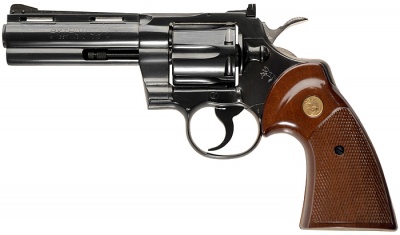
I don't think any caliber less than a .38 Special is adequate for home defense or self-protection, unless as a back-up. The cardinal rule of a gun fight is to have a gun, yes. But in self-protection, you want more gun. But beware: Shoot a magnum round indoors in a closed room and you'll never hear again. Magnums are cannons that should only be fired outside and while wearing hearing protection. You may be deaf for an hour shooting a 9mm, a .40 S&W or even a .45 acp, but it'll likely be temporary. Shoot a magnum, and it's permanent. That's why I do not recommend a .357 magnum or a .44 magnum for home protection. If you have one, like this gorgeous Python below, use .38 Special rounds (or for the .44 magnum, the .44 Special). The rounds will work in these guns.

Be concerned about over-penetration and under-penetration. With the former, your bullets go through bad guys and people and walls behind them; with the latter, your bullets don't penetrate skin. Use hollow-point bullets, or jacketed hollow point rounds, so your bullets fragment and don't go through as many walls. Fully jacketed rounds will over-penetrate, go through your target and anybody or anything behind them, perhaps deflecting into unknown and unpredictable directions. Fully jacketed rounds are considered target or range rounds. Don't use them in your home defense gun, except at the range. 

But a non-jacketed hollow point fired out of a short barreled pistol, may clog with heavy cloth such as a winter jacket and not pass through to the bad guy's organs. The Shooting Sports and Ammunition Institute (SAAMI) has standardized bullet specifications. Manufacturers make ammo to these specs, and they also make ammo that exceeds SAAMI specs. Most manufacturers make Home Defense loads that tend to be jacketed hollow point +P rated, meaning these rounds exceed SAAMI specs by one level. +P+ rounds are scarier still, and using +P+ rounds on guns not rated for them may blow up your gun. Most pistol manufacturers state in their small print that using +P+ rounds will void their warranty. And if you use +P+ rounds on a bad guy, or if you roll you own so to speak, expect both a prosecutor and a civil lawyer to claim you were eager to kill...and overkill

And be aware of a peculiarity. In tests against ballistic jello formulated to match characteristics similar to the human body, a 9mm full jacketed bullet exceeded a .45 acp bullet in penetration. Again, think about where your bullet will go.

ballistic gel comparison

Man-stopping rounds are the .357 Magnum, the .40 S&W, the .45acp and larger. The 9mm, not so much. Those who like the 9mm argue capacity (number of rounds available), cheaper practice rounds and less recoil, important for follow-up shots and the flinch factor. Those who don't like 9mm rounds argue that the bad guy may not go down. They use the famous April 11, 1986 FBI disaster, when the 9mm toting Feebs were out gunned by bad guys, an instance that led to the development of the 10mm round and its offspring the .40 S&W cartridge (when the 10mm proved to be too powerful), as proof. And they've got a point. But the 9mm cartridge has a strong following, and I'm one of them. But for home defense, I use a .40 S&W; it's got a little more man-stopping oomph.

What Gun to Buy?

My first response is a shotgun, but we're talking pistols here. Damn! Somebody keep me on target.

The pistols I've referred to here mostly are Glocks. And there are some reasons for that. They work, for one, no matter what you do or don't do to them. Second, they're cheap. If you ever have to use your gun, you'll never see it again, at least not in any shape you'd want it. Cops don't treat evidence guns well. Neither do plaintiff's attorneys. Plus, Glocks come in any caliber or size you'd want. Yes, they're ugly as hell, but they work, they're cheap and a Glock is a Glock: they're damn near indestructible.

Sig Sauer P220

For feel, I love a Sig Sauer. They seem to fit a hand like a glove. And they point well. But unless you buy a plastic one -- models I happen to love -- they'll cost you about double the price of a Glock. If you want a German engineering masterpiece, albeit at a hefty price, buy a Heckler & Koch. Smith & Wesson makes numerous models, too, both in revolver and semi-auto flavors. And Springfield has a new XDm line, which is receiving rave reviews. They too offer different calibers and sizes. And, of course, the old timer, the 1911, which usually comes in either 9mm or .45 acp.

1911 by Nighthawk Custom
I choose a Glock 35, their competition model in .40 S&W, and I have mine fitted with night sights. (I also have a shotgun.)

But what you should do is choose your own pistol. Go to a gun range that offers rentals and try several. Get one that fits you and that you shoot well. And get it at least in .38 Special. Then buy some Home Defense jacketed hollow point bullets. But above all, practice, practice, practice. It's not just fun to shoot; it's an investment in your family's future.

Saturday, May 5, 2012

Home Defense, Part 2 -- The Shotgun


by Ben Small


Assuming you've decided a home defense gun makes sense, what gun should you choose?

I don't think anyone argues with the notion that the best home defense weapon is a shotgun, but that begs the question. What type of shotgun, what size shell, what size ammo?

Shotgun gauges vary inversely to number progression. So the larger the gauge number, the smaller the bore. Doc Holliday carried a 10 gauge at the OK Corral, a cannon rarely seen today. For a guy as skinny as the sickly Doc, his shoulder must have been numb for days. A 12 gauge has a smaller bore diameter than a 10 gauge, and 16, 20, 28 and the .410 gauges have respective still smaller bores. The most popular shotgun gauge today remains the 12, however, anything larger than a .410 will provide ample home defense protection. While the Taurus Judge has made the .410 shell -- a round once believed to be mostly obsolete -- popular,  the .410 is generally not recommended for home defense. It's just not accurate beyond ten feet.

Choose your shotgun gauge by considering your size and age, not to mention level of comfort. The older you are, the less tolerant your shoulder will be. Any gauge other than a .410 is adequate for home defense. And choose the size of shells you're going to use bearing in mind the same considerations. Many shotguns these days will accommodate three different size shells, usually 2 1/2", 3" and 3 1/2". The latter two are often called "Magnum" and "Super Magnum" respectively. Trust me: You don't need a large shell to be effective for home defense. Stick with the smallest shell available for your shotgun's chamber.

Shotguns vary by type of feed, too. Some are single shot, some double barrel, some over-under, some semi-automatic, and my all time favorite, the pump. I highly recommend a pump shotgun for home defense. I don't think anyone doesn't understand what's behind that ominous click-clack. Pump that hummer, and you may not have to shoot.

Shotguns come in pistol-grips too, but I don't recommend one unless your name is Arnold and you were once governor of California. Anyone with osteo or rheumatoid arthritis certainly doesn't want to shoot one. I cringe even at the thought of it, but then again, such guns are usually pump actions, so the click-clack may make firing unnecessary. I've got one --  no, Ben's not a pseudonym and I've never run for office -- but I've never fired it. One ugly-scary looking beast. 


Ouch! Doesn't that look painful? Grip it tight or recoil may be a bop on the bean.

But let's assume you've determined your gauge and type of shotgun. What size ammo to use?

A slug is essentially just what you imagine: One big plug of steel or lead, usually fifty caliber. That's a lot of whammy, and will be the most painful to shoot at whatever gauge you've chosen. While slugs are good for deer or elk hunting, I don't recommend them for home defense. Besides, the only thing you're likely to hit may be your neighbor two houses over.

Before choosing your size of ammo, you need to understand why a shotgun is the best weapon for home defense: You don't need good aim. Flinch away. Because shotgun barrels -- except the Taurus Judge-style pistol -- aren't rifled, the pellets inside won't spin. So instead of a true and accurate spiral, like from a rifle or pistol barrel, the lead or steel pellets inside the shell spread. The spread will pattern outward. You can adjust the pattern spread by insertion of a muzzle-choke to squeeze your lead or steel shot any way you want, horizontal, vertical or any combination in between; but you don't need a choke. Expect about a two foot diameter spread twenty feet away without one.

Shot shells vary by size and number of BBs inside, again inversely to number progression. In other words, the larger shot shell number, the smaller the BBs and the more in number. See the following size scale:


The low number shot shells (OOO, OO, O, 1-4) are usually called "buckshot" or "buck". Consider that these are essentially 9mm bullets, which will penetrate bad guys, your walls and maybe your neighbor's, too. Again, while such rounds are good for killing deer or humans, I don't usually recommend them for home defense, unless loaded as a last resort after having already fired rounds of bird shot (shot shells 7-9). Some might disagree about using bird shot for home defense, but if the click-clack doesn't scare an intruder away, a body penetrated with up to seventy or more BBs from bird shot surely will. And close up, bird shot will devastate. Even with the Castle Doctrine -- now being considered in Florida in connection with the Trayvon Martin shooting -- your goal should be protection, not intent to kill. So for my home defense, I load my shotgun with bird shot first, buckshot last. Six rounds of escalating fire power.

The only downside to choosing a shotgun for home defense -- other than the owie-factor, of course -- is where will you keep it? Do you have children, for instance? Do you need to keep your shells separate from the gun? Do you have a safe to accommodate it? Can you access your gun and ammo, load and rack your slide in time?

I do not recommend flashlights attached to shotguns because the bad guy will see you first and your ambient night vision will be ruined. But others may disagree, and it's so tacti-cool to have one.

Click-clack, I'll be back. In Home Defense, Part 3, I'll discuss home defense pistol options.


Saturday, April 7, 2012

Home Defense, Part One


by Ben Small

It's three o'clock in the morning and a strange sound awakens you. The tinkle of falling glass, the scrape of a chair across a terrazzo floor, maybe the clink of silver pieces dropped into a bag.

What do you do?

Home invasions are on the rise, no doubt due to the economy and the rising drug trade, the number of addicts in need of fix money. And the number of home owners buying a weapon to defend themselves are on the rise.

But when faced with a home invasion, what do you do? You need to think about this, because it could happen to you. Indeed, it happened to me some years ago.

I'm not going to write about what home defense weapons are the best, for now. I'll save that for Part II, to be run at a later date. Instead, I'll talk about defensive considerations. And you should think about them. Indeed, you should have a plan.

One home defense expert has said that in a true home invasion, you may have as little as eight seconds to react. If that's the case, you may or may not have time to reach for the phone to call 911. And you should try to do so, unless it's obvious that reaching for the phone will get you dead.

But let's say you're awakened and you're not sure what you heard. Lie still and listen. Your cat may just have knocked something over. But if it's a burglary, you will likely hear further movement which will confirm your worst fear. Then you reach for the phone.

Same thing for your home alarm going off. It may just be the wind. Stay still for a moment and listen. If a break-in is confirmed, dial 911 before your alarm company calls you back.

Massad Ayoob, noted author, cop, founder of Lethal Force Institute, Inc., the Massad Ayoob Group, a training academy for police and civilians both and an expert witness for both prosecution and defense, suggests the next thing you should do after dialing 911, is put some clothes on. You will feel much more self-assured with clothes, even a bathrobe, than stark naked.

If you have a weapon, don't put it under the bed. Bugs, dust bunnies, anything that can move into your gun barrel, can cause a catastrophic failure. Don't put a gun under a pillow. You may have a dream and shoot your spouse or yourself. Same thing with a night table. Instead, keep the gun in a handgun safe that can be opened with no light, either by touch or feel. You don't want to be looking around for a key in the dark.

Which brings up another recommendation by Ayoob: Keep the lights off. If you're silent and in the dark, an intruder may not realize someone's there. Your eyes will adjust, if they're not already. Yes, making noise may scare an intruder away, but if he's high on drugs or has a harm agenda, noise will tell him where you are. You know your residence better than an intruder does; make use of this information.

Whisper to your spouse to be silent and either get on the floor on far side of the bed or walk quietly into the closet, especially if the closet door has a lock. The mattress will provide some protection, and if the intruder doesn't kill you both right away, he'll probably put you in the closet anyway. The intruder will be in a hurry. If he can't find you, he can't shoot you. And the last thing you need is a spouse yelling, hampering your thoughts or giving away your location. Your focus needs to be on protection, not diluted by worrying about where your spouse is or what he or she is doing. You do not want him or her peering over your shoulder.

Assuming you have a weapon and want to ward off the intruder, consider whether you can shoot the intruder. Many states have a Castle Rule. Under the Castle Rule, for a successful prosecution against you, the prosecution must prove beyond a reasonable doubt that you had no imminent fear of deadly force. But some states, like Wisconsin, have reversed this rule. You, the shooter, must prove beyond a reasonable doubt that you feared imminent deadly peril and that you had no other less deadly means of defending yourself -- a very difficult standard to overcome, especially when it's dark and you don't know if your intruder is armed or not. Shooting someone for stealing your stuff will send you to jail in these Castle-reverse states.

Do you fire a warning shot? If you do, you tell the intruder exactly where you are. Indeed, he may even see your muzzle flash and aim directly for that. Again, most intruders interested only in burglary will flee. But how do you know this intruder's agenda or the condition of his mind?

Depending upon what you've learned from listening to the intruder and considering where you are and what your state law provides, make your decision as to warning shot or not.

Time is on your side. The longer your intruder is in your home, the greater risk he runs. Do what you can to buy time. If you called 911, help is on the way.

But let's say your phone lines have been cut or for some reason you didn't call 911. Should your weapon be equipped with a light or laser?

I like lasers and don't like lights. I'll tell you why. A laser is harder for a bad guy to spot than a light. And a red dot on someone's chest usually gets their attention; it tells them you have a bead on them. But it also tells him where that bead is coming from. Still, the laser dot is harder to spot than a bright flashlight, so you may have several seconds advantage with the laser, plus you'll have your target down pat. Plus, a laser doesn't destroy your night vision. A flashlight or strobe does.

I don't like flashlights attached to guns. While you're searching with the light for where the bad guy is, he knows exactly where you are, and he will probably find you before you find him. Bang, you're dead. If you're going to use a flashlight, hold it over your head and to the side and put it on strobe, so the bad guy's aim may be thrown off. You'll see this tactic on some Sportsmen's Channel personal defense shows.

You don't need an expensive weapon. If you do shoot, count on being fully investigated with a good probability of being prosecuted. You'll never see that gun again, or if you do, it won't be in good shape. Cops don't take care of custodial guns; indeed, they often ruin them.

Don't brag to your buddies about how well prepared you are to defend yourself. Don't show off your guns. Don't tamper with the factory trigger or use handloads. These tidbits can and will be used by a prosecutor to show intent to kill or maim. Yes, you were invaded, but you are the defendant, in both a criminal case and the sure-to-follow civil suitAnd since you intended to fire, your insurance policy probably won't cover you for damages -- maybe not the costs of your civil case either.

If you and your spouse have followed these suggestions and have done what you can to protect yourselves, not having fired a shot, the standard for self-defense may be higher than if you have others in the house, like children, who also need protection. You're entitled to protect them too, so a prosecutor weighing all the facts will accept more aggressive actions on your part in these circumstances.

Bottom line: You have to make these decisions, and they aren't easy ones. They'll have to be made quickly. You'll have to take what you see and hear and make snap decisions. The more time passes, the harder your decision, especially because assuming you called 911, help is on the way. The prosecution and civil risk rises with the passage of time.

And that's why you need a plan.

Sunday, March 18, 2012

Mercenary!

by Ben Small


Mercenaries -- guns for hire -- have existed for thousands of years, dating back at least to the ancient Romans, but a recent website, sent to me by a former SEAL interested in a mercenary career after his military service, caused me to open my eyes. Here's the website. The World's Most Powerful Armies

I suggest you take a look, and I wonder if you're as surprised as I was. Yes, I'd seen the furor over Blackwater's activities, seen the hub-bub over private contractors' work in Iraq and Afghanistan. But, frankly, I had no idea the extent to which highly-trained retired warriors are being used and funded around the world. I had no idea the business of being a well-equipped mercenary is a growth industry.

But the trend makes sense. The military training our elite warriors receive is extraordinary. The SEALs, Delta Force, Green Berets, Marines, Revolutionary guards, Legionaries, etc. all receive rigorous conditioning, are mult-weapon functional, and the weapons available to these modern warriors are highly functional and effective -- deadly. Plus, there's a world-wide weapons trade to support them. Want to buy AK-47s in bulk? They're available just about anywhere. South and Central America do a booming trade in them. Want a rile that fires an air-burst, a round that sprays shrapnel above a target? It's available. Want a computer operated rifle, one that determines range and balances load automatically? It's available. Grenades? Sure, why not. A rocket launcher? No sweat. A battle helicopter, no problemo. A nuke? Who knows...

For years, we -- and others -- have been training and utilizing these highly effective warriors and incorporating them into a military machine like no other in the world. The best equipment: ordnance, weapons and protective equipment. The best conditioning: strength, stamina, stealth and speed.

And while we train our warriors to the nth degree, in the U.S. we tend to pay them squat and run them in and out of service. Plus, we saddle our soldiers with Rules of Engagement intended to walk the wavy, gray line of political correctness, a line that changes with the need to placate whomever our actions have offended. Then, when someone alleges we've violated an enemy's honor, or "tortured" however that term is defined, we investigate and vilify those we've hardened into effective soldiers.

Under these circumstances, why wouldn't our very best and most trained warriors decide to further their pursuits elsewhere, somewhere for instance where these oppressive rules don't apply and where the pay can make them rich? They'd be foolish to do otherwise. What else are these veterans to do? What's their job market look like in other endeavors? We've conditioned these people to kill quickly, silently and effectively. That's what they do best. And if we won't let them do it the way they've been trained, if we won't pay them for the risks they incur, and if we're going to give them proctoscopic treatment whenever they come back from a mission,  and provide them no jobs, why wouldn't they look elsewhere, utilize their skills in the way they know best -- and profit from it?

And hiring mercenaries offers our government, among others, an out. You can hire someone to do what you cannot do and then claim when you learn what they've done, that you didn't know. Torture is a difficult definition, one that changes over time. Water-boarding is now torture, so is causing pain or injury or putting a prisoner under duress. Playing loud, heavy music is torture. That one's obvious. You learned it from your teenager.

But these restrictions apply to our military, not necessarily to those serving as a contractor. Distinctions tend to blur when issues arise as to who did what to whom and under what authority and where. Employment and duty records may be kept overseas or encrypted. Access to them may not be possible. And whose law governs a mercenary in foreign lands?

And there's another benefit to our government. We can claim to the American people that we're leaving a country, scaling back our military, and then hire contractors -- albeit at higher cost -- sell them weaponry, even aircraft and artillery, and bury these costs under one of our many covert accounts. Want to claim we've left Iraq? Okay, just hire contractors to replace them.

Think Haliburton.

Yes, Blackwater folded. But other similar training agencies and mercenary services popped up to replace Blackwater. Mercenary training and employment have become growth industries. Google "mercenary." You don't have to be more specific. You'll find all sorts of employment and training opportunities. As I said, a growth industry. And one that pays well.

Given this plethora of mercenary opportunities, and the growing trend of hiring them...everywhere, another natural question arises: To what degree are we fighting ourselves? In other words, a case of we train 'em, you hire 'em, for whatever, whomever, wherever. Sell them what they want and let them use it against each other, perhaps both sides funded from the same source: us.

Hamid Karsai hires these mercenaries and so do other Middle East and third world countries. It seems every petty dictator and dictator-in-training has them. And what's more, if Americans cannot satisfy international demand for them, there are plenty of third world nationals that we've trained and equipped who can.

Some may claim that mercenaries fighting mercenaries is the way battles should be fought. Not me. Mercenaries have loyalty to only one god: money. In many cases, there's no love of country or god; they'll fight for who pays them. And what happens if these highly trained warriors organize and decide to take over a country? There are certainly enough of them to do so, and they can buy the weapons they need on the open or black market.

Yes, Dick Cheney utilized mercenaries to good advantage, at least from his point of view. But Obama promised change. While we've imposed ridiculous Rules of Engagement on our official troops, we've encouraged and turned the mercenary industry into a very profitable, growth endeavor. Indeed, covert operations and government lies about them are exploding like bees from a burning barrel.

Robert Ludlum should be alive today. His grandiose conspiracy theories don't sound so implausible now.

Meanwhile, I'm thinking of hiring my own mercenary. My driver's license needs renewing, and I don't wanna wait in line. I'll equip Chuck Norris with this:

Saturday, March 3, 2012

Range Day Lessons

by Ben Small


It's a good thing my neighbors can't see what I took out of my trunk last Saturday. An M4, a M1A, a Glock 34 and an XDm. For those who don't know, the first two are battle rifles, the latter two semi-auto pistols. Two of the above hold thirty rounds or more, one twenty rounds, one sixteen. I'll let you figure out which is which.

Guess you can tell: I spent the day at the range.

There's a certain exhilaration from firing a firearm, a release of tension and a dose of either immediate satisfaction or disappointment.

Sorta like a modern era third date.

And it's tiring. I was haggard all evening, exhausted, de-hydrated and spent.

Sorta like the morning after that modern era third date.

But there are always lessons learned from a day at the range. And last Saturday was no exception. Just observe. You'd be crazy not to look around. People are firing live ammo, you know.

I noticed two things Saturday that at first glance might appear to be unrelated. Not so. Indeed, they represent illustrations of something that writers about shooting should understand.

Let me tell you what I saw.

First, I saw an eight year old girl shooting a .22 rifle from a rest, her barrel supported on a sandbag, the butt end on her shoulder. Her target stood ten yards away, with holes all across its four foot span. The rifle, an old Winchester, a lever gun, its wood stock chipped and gouged, the bluing of its barrel only partially remaining. No rust, no butt-pad. The girl's parents stood behind her, marveling at the way she worked the smooth action, laughing when she said she aimed at the target's armpit. Occasionally, one of the parents would shoot another, more powerful rifle at the table next to her. Their guns were newer, but their setup was the same, barrel on a sandbag, butt on the shoulder. Their targets stood at fifty yards, but their aim wasn't much better than their daughter's.

At another table, a man struggled with accuracy from a brand new rifle. His fifty yard shots spaced too all over his target, the rounds key-holing. I knew his rifle; I own one similar. I knew the ammo he used.

Why couldn't these folks hit where they aimed?

Simply put: harmonics, torsional vibration they'd screwed up. Their stuff wasn't working well together.

As I learned from years of working with engineers who designed complex equipment incorporated into sophisticated systems worked into products which accomplish complicated tasks, everything vibrates, even stationary objects. We just don't always recognize vibration because we can't always see it; we can't always feel it. But when the separate vibrations of components combine into a whole, the vibration of that whole is called "torsional vibration." And when that torsional vibration goes out of tune, things go wrong.

Think of the weird shaking of your car when you hit a certain speed. Go slower or faster and the vibration disappears. Sometimes that vibration can be severe; indeed, such out of tune vibration can tear some of the components apart. In vibration terms, the out-of-tune harmonics are called "criticals." A critical occurs when something vibrates at its own frequency instead of in a harmonized blend. It shakes, rattles and rolls.

Bored yet? Be still; I'm getting to the point.

Let me tell you what each of these people did wrong.

The girl and her parents: They rested the barrel instead of the stock on sandbags. While their rifles were cared for, in no worse condition than most, her parents didn't realize that by resting a barrel on anything, they ruined the barrel's float, throwing off the rifle's harmonics and causing it to fire differently with each shot. A rifle is designed to minimize any direct link interference between the bolt, action and barrel. It's designed to spiral a balanced round straight through a perfectly round tube and out toward a target, all at thousands of feet per second.

Like how Peyton Manning fires a perfect pass to a receiver, scaled differently of course. Ever see a wobbly throw? It's hard to toss a perfect pass when one's arm is smacked during the throw. Same principle for this girl and her parents, their rifles (throwing arms in this analogy) operating at much higher pressures and speeds than any linebacker nailing poor Peyton.

And same result: no accuracy.

The other guy: Wrong bullet weight for his rifling. That's why he had no accuracy, why his target looked as if someone had thrown keys through it.

You see, the guy fired a weapon with 1:9 rifling, and the spiral couldn't stabilize the heavy bullet he used. Every rifle barrel is cut into lands and grooves. They cause the bullet to spin. To spiral, a heavy bullet needs a fast spin. Otherwise it wobbles -- "tumbles" in rifle parlance. And tumbling causes key-holing in a target.

Again, think of a football: the heavier the football, the more spin required to make it spiral.

A 1:9 rifling means a bullet makes one turn in nine inches. A 1:7 rifling means one turn in seven inches. So a  1:7 rifling means a faster spin. Sorta counter-intuitive, isn't it? The lower number on the ratio denominator means a faster spin.

This guy would have been better served with a lighter bullet weight. The rifle functioned properly; he just didn't mate it with the right bullet. The torsionals were off.

Of course, I could have butted in and said something to the girl, her parents and the other guy, but, well...we all know people who do that sort of thing...butt in, that is. One can usually tell when someone wants help. They say something; they scratch their heads, or they stare at you with that lost look. I got none of that. Despite no accuracy, these people were having fun.

Well, okay, I lie...maybe just a bit. During a break, the guy came over and remarked about my tight target groups. As often happens during range-break chats, we discussed our rifles. When I told him I owned a rifle similar to his, he asked what ammo it ate.

Wham, bam! I threw a perfect spiral right through his open ear hole.

Just like Peyton Manning.

And, well...I learned something, too. I learned that if I don't clean my XDm once in a while, it occasionally may not fire.

Some people -- like maybe...me -- are just idiots.

Saturday, August 20, 2011

Feeding Your Rifle

by Ben Small


In 1964, Winchester made a change heard around the world. For years, Winchester had produced its famed Model 70 rifle to rave reviews and aggressive sales. The Model 70 had become known as "The Rifleman's Rifle." But the company faced rising production costs, and decided to make some changes to the model. Production changes, no big deal. Just some minor design changes that enhanced producibility at cheaper cost.

And yet these changes killed the Model 70. The new model did not find favor in the marketplace, caused sales to plummet and ultimately sank the company. Winchester stopped production entirely, and then sold out to a Belgian firearms manufacturer, FN. Wisely, in 2006, FN reissued the Model 70, returning to the old design and adding a few new features.

What destroyed the market for the Model 70 post-1964? Traditionalists will argue that you don't fix something not broken, that quality issues increased after the move to cheaper production methods. But, others will argue that it was the change from control-feed cartridge insertion to a push-feed bolt that destroyed sales.

Top: Post-'64 Model 70 bolt
Below: Pre-'64 Model 70 bolt

Go to any gun store that sells used rifles and compare pricing on Model 70s pre-'64 and post-'64 from '64 to 2006. You'll find that a pre-'64 Model 70 will cost double or more the price of a post-'64 Model 70, pre 2006.

Why? What's the difference between "control-feed" and "push-feed?" Which one is better?

As a writer, if you're going to use rifles in your plotting, you may want to take notice of this issue, because it offers some details that even a non-gunner can use in his/her story, preparing the good guy or the bad guy for the key shot, tracking his thought pattern through the shot.

Essentially, "control-feed" bolts are those which have a large claw extractor built in. Mauser invented this methodology for round feed, and it's still in use today on Model 70s, Mausers and other rifles using the Mauser load principles. Essentially, the way this works is a round is pushed up from the magazine, grabbed by the claw extractor and then held in place by the extractor, is fed into the chamber by the push action on the bolt handle. There's no jostling of the round; it's in the firm grip of the extractor.

Mauser Claw Extractor (Top)
In a "push-feed" mechanism, there is no claw. The round is pushed up from the magazine into the action, where it is aligned into the chamber by the forward action of the bolt only. There is no extractor holding it in place for insertion. The chamber channel flutes so the push action alone places the round where it's supposed to go.

Your rifleman will know whether his bolt action rifle is control-feed or push-feed. Each has its own advantages and disadvantages, slight perhaps, but enough to kill the market (at least emotionally) for the Model 70 after it changed its design in 1964.

I asked a friend, an engineer knowledgeable in the fine aspects of shooting, what he thought of the difference between these two mechanisms. He shrugged, said, "Dunno. About the same in my book, re accuracy, I'd guess, but it's hard to chamber a push-feed round when you're hanging upside down in a tree."

And right he is. Without the Mauser claw extractor, attempting to load a push-feed rifle while hanging upside down would cause the round to fall out.

But how many people shoot that way?

Another difference relates to speed of your bolt insertion. With control-feed, it makes no difference, because the round is held in place by the claw. With a push-feed bolt, a slow push forward may cause the round to stick somewhere on the chamber ramp. A straight, smooth and firm bolt push will usually drive the round home with no problem. So, with a push-feed bolt, you want a firm, forward pressure to put the round in place. If the shooter's nervous, for instance, or hesitant, he or she might hesitate or slow the pushing of the bolt and round into place, which may cause a stick and maybe require a finger insertion to straighten the round. This may make a bit more noise than locking a round in with a control-feed bolt. And noise is an enemy to a stalker or sniper.

So, these considerations make a control-feed rifle, like the modern or pre-'64 Model 70, perhaps preferable
to a push-feed mechanism.

But there's a disadvantage to a control-feed action: Loading a single round into the open chamber rather than up from the magazine leads to a problem. The claw must first clamp onto the round's rim. That means bending the claw, and extractors are not meant to be bent. So you risk damaging the extractor, which means a trip to the gunsmith.

If you watched "Shooter," an excellent  Mark Wahlberg movie, there's a key scene where Wahlberg's character is slipped a round and he drops it into the chamber of his .338 Lapua Magnum sniper rifle and jams the round home, before pulling the trigger and demonstrating that he'd switched the firing pins so the rifle wouldn't shoot.

He could only drop the round in and slam the bolt home in a push-feed rifle.

Excellent rifles come in both modes. Winchester's Model 70 is probably the most popular control-feed rife on the market, indeed in history, post-'64 to 2006 excepted. Other renowned names like Savage, Weatherby, Remington 700 and Kimber, are all push-feed.

Which is better? Is there any effect at all on accuracy?

Who knows? There are as many opinions as shooters. There's no question that the switch from control-feed to push-feed killed the Model 70 market from 1964 to 2006, but most people feel that the aversion to that change was more emotional than practical. Indeed, it's easy to find articles that claim the post-'64 Model 70 action was actually an improvement, one that the market just didn't accept. Indeed, I accept that reasoning; so much so, I looked for, found and bought a post-64 Model 70 in .270. It's one of the most accurate rifles I own. Plus, I don't shoot upside down hanging from a tree, so the feed difference means nothing to me.

The difference really, unless you're shooting upside down, is minimal. But in shooting, everything matters, especially to engineers, as a rifle is really just another piece of machinery. Engineers love to argue about O-rings, tolerances, lube and micrometers. And for the most part, the issue of control-feed vs. push-feed, is one of those issues, about which some will never agree and may argue about relentlessly.

So, while control-feed vs. push-feed may not make a big difference to the part-time or casual shooter, to a killer or one who's familiar with rifles and using one for defense, the difference may be important. And he or she will be very aware as he feeds a round which system he's using. He may even imagine the click of the Mauser claw onto the rim of a cartridge, or he may feel the resistance the chamber ramp may provide as he pushes the bolt on a push-feed system. Either way, recognition of the feed mechanism and its particulars can be made a description or detail point in a story to add realism or suspense.

A short video from the owner of Midway USA, a major firearms parts supplier, demonstrates these differences in a way you can visualize. Bolt Action Feed Video


Which rifles are control-feed and which are push-feed? I've given some suggestions, but to be wise, before you're going to use a rifle in your story, Google it, and look at the specs. One of them will mention the type of extractor or the feed mechanism. If there's a claw extractor, it's control-feed.

And consider...Will your shooter be firing upside down?


Saturday, April 16, 2011

Snippets...

by Ben Small


In my own Stupid Kindle Story, a topic I've seen covered before, I think I've got a winner. I bought a new Kindle, 3G and all, because I got tired of losing my place on the old one. You know: a twitch, a bump, whatever... No idea where I'd been.

So I pulled my new Kindle out of the package, only to drop it because I had no idea how the hard cover with slots -- ordered separately, mind you - worked..

Yeah, duh.

One return later, still unable to work the stupid cover, I ordered another hard cover, one with a built-in light running off the Kindle battery.

Cool. I can read in the dark.

So the package arrives, and it's the same cover I'd already bought, the one with the slot I couldn't figure out.

Donkey duh.

Maybe I should read directions...
---------------------------
Charles McCord
Michael Jordan had Scottie Pippin, Johnny Carson had Ed McMahon, and for about thirty years Don Imus has had Charles McCord. Charles doing the news, sidekick superb, a joke-writer, a stand-up-quality comedian; Charles, whose rants back against the ever-insulting Imus as either a voice of reason or a total nutjob should someday grace my iTunes library. 

McCord announced his retirement Friday, effective May 6.

As a key piece of what has become three of the most entertaining radio and television programming hours five days a week for thirty years, Charles will be missed. And as he made Charles' announcement, Imus snorted that after forty-eight years of going home to  his family early each and every afternoon, Charles has decided to see them less. He's going to sit on some Arkansas lake, alone in a boat, fishing... Then, mentioning his prostate cancer -- for maybe the hundredth time that hour -- Imus compared Charles to Newt Gingrich, who served his wife with divorce papers while she was in the hospital. 

As usual with Imus in the Morning, hilarity ensued.

Saturday, April 2, 2011

Mad About Hunter

by Ben Small


I started reading Stephen Hunter before I adopted shooting as a hobby and before I realized I'd best learn something about guns if I wanted to include them as part of my plotting. Yes, the old putting a safety on a Detective's Special .38 Special thing again -- they don't have one. Peeling my editor off the wall thing.

And frankly, I didn't have much of a clue what Hunter was writing about. While I found his story intriguing, fast-moving and a page-turner, I skipped many of his gunnery details because I didn't know enough about guns to even fire one.


After my editor's outburst and very long lecture thereafter, I bought a few guns, primarily for their manuals, so I could ensure at least some details would be accurate. Then I took one of them -- an AR-15 -- out to the woods, fired one round -- not realizing I needed hearing protection -- and scared the hell out of myself. I hit the milk carton, I think, but was too busy scrambling back toward the house -- scared to death that my inability to hear would be permanent -- to look.

I should have read more Hunter.

Stephen Hunter is recognized as the best sniper novelist on the planet. His character, Bob Lee Swagger, a retired Marine sniper, is beloved by shooters everywhere -- hunter or paper-popper like me. As a shooter, I learn more about guns and how to use them from Hunter's novels than I do from subscriptions to Guns & Ammo or Shooting Times, magazine staples for most trigger-pullers. Because Stephen Hunter has a nose for details, the minute parts of a complex story that one doesn't realize are important until they're assembled into a slap-the-side-of-your head denouement.

Novel after novel -- one exception, The 47th Samurai, where for some reason Swagger journeys to Japan for a sword-fight with a legendary Japanese Samurai -- Hunter finds gun details (scopes, firing pins, ammo, calibers, sniping artistry, ballistics, accurizing, setups and other variables) that may seem insignificant to most, but are critical to a satisfying, can't-put-down story.


Take Shooter, for instance, the movie starring Mark Wahlberg as Bob Lee Swagger, which is based upon Hunter's novel Point of Impact. If you watch the movie, you may feel you need not read the book. Au contraire. For while the movie covers the book's premise -- albeit with some differences -- the movie settles for simplicity rather than the careful piecing together of a complex puzzle assembled by Hunter. Yes, the movie has a brilliant denouement, a masterful piece of crafting no doubt supplied by Hunter, but the revelations, settings and step-by-step plotting -- not to mention the finale -- vary by order of magnitude, like comparing a .22lr round to a ..22-250. (Both are .22 caliber bullets. But one is rimfire, the other is center-fire; one for gophers, the other for coyotes or deer; one gives a small pop, the other will deafen you; and finally, one costs $6/100, the other a buck per round.)

You may have heard of Stephen Hunter. He won a Pulitzer Prize...as a film critic. I haven't read one of Hunter's film pieces, but I'm working my way through all of his twenty-two acclaimed books, most of them Bob Lee Swagger novels.

And the funny thing is, Stephen Hunter has never been a sniper. Hunter grew up in a Chicago suburb to academic parents who forbade guns in the house. After becoming hooked on Dragnet, Hunter started sketching out gun designs on notepads and writing gun novels at age ten. Then he attended college, and like most college students, Hunter drifted Left and actually protested for gun bans. Finally, as an adult, Hunter stopped denying his inner voices, and he returned to his first love -- guns.

And Hunter's been firing off highly acclaimed novels ever since.

Writers often ask me about gun details, and I've penned a few blogs about them. Why? Because, like Hunter, I've become fascinated by weaponry in general and guns specifically. And it's a shame so many authors miss plot opportunities associated with their chosen weaponry or get details about the weapon (or its use) flat-out wrong. Yet Stephen Hunter takes me to school, about writing and about how to make details -- in this instance, gun details -- important. He's also taught me that if one is going to make a gun important to a plot, you can bet the book's shooter paid attention to detail. And if we're following the steps of the shooter, we should know how he prepared for what may be the critical book event.

So yes, I'm mad about Stephen Hunter. So much so, I may even read one of his film pieces.

Saturday, February 19, 2011

Family Fun

by Ben Small


Crisis in our family. Stress Week. Panic Central. The family is coming to visit, starting tomorrow. Six adults, one three year old girl.

So, of course, everything has gone wrong. First, we suffered a natural gas outing for four days. No warning, little advice on when  it would flow again. Cold showers, no heat, frigid temperatures...in Tucson.

Bundled up like an Eskimo, my wife laid out an agenda. Every visit day covered: activities, meals plus a birthday party for the three year old. So we went to Costco to stock up, and so my wife could hopefully do all the cooking in advance.

That's when we realized we had no room for all the frozen stuff.

So we bought a freezer, added it to the mess in the garage.

Then the refrigerator died. My wife swiped my beer refrigerator, emptied out all my coveted brews, and stacked it full with perishable stuff. Some of this stuff wouldn't fit, but the GE guy said he'd come over immediately and fix the fridge.

But the fridge needed a part, an expensive one. We weighed just buying a new fridge, and could have had it installed before the kids arrived, but GE said no sweat; they'd repair the problem well before deadline.

So we waited. Day after day, as the panic level rose and more unstashed food spoiled. We called GE. The technician was sick, they said. Had the flu. We asked for another technician, but were told the one assigned had the part, it was expensive, and GE wouldn't send another part and assign another technician.

So we waited again. Each day, we'd get a call, saying the technician was still sick but would be out "tomorrow."

Tomorrow took a week.

So the kids arrive in less than twenty-four hours, the fridge got fixed today, and we're off to Costco again to buy more of the stuff we bought before.

And that's the easy part. Now my wife is cooking up a storm, while I clean up and do other chores. Sweeping, vacuuming, assembling presents and a car seat.

Who said retirement is easy?

P.S. I saved the beer.

Saturday, January 22, 2011

The Birthday Present

by Ben Small


My friend -- let's call him Mike -- came by yesterday. I thought maybe his dog had died, he looked so pained. I waved him inside and met him at the door.

"What's wrong?" I said. "Something happen to Bootsie?" That's the dog.

Mike gave me a far-away stare. He raised his hands, then dropped them again, took a deep breath. He shrugged. "I blew the birthday present...somehow."

Amy, his wife of fifteen years. Her birthday was yesterday. I posted her a greeting on Facebook.

"You didn't get her anything?" I waved Mike to a seat, half because I really wanted to hear this one, but also because he seemed wobbly on his feet.

He dropped like an anchor into the stuffed easy chair next to mine.

I groped for the clicker, pausing I Love Lucy. Yeah, I like that show. "So what happened?" I said, as Lucy stopped mid-wail. "I gotta hear this one."

"C'mon," Mike said. "This is serious."

"Okay," I said. I shot him a look. "So...tell me...what happened?"

Mike sat back. "You won't believe it. Hell, I don't understand it. I have no idea what I did wrong."

"Dammit, Mike," I said. "What did you do?" I held up a hand. "Sorry, want a beer? I should have asked first."

Mike shook his head. "See..."  He took a breath. "I've asked Amy for three weeks what she wanted for a birthday present." A beat. "In the past when I've bought her stuff -- a Kindle, for instance -- she sent it back." He took a breath. "Frugal. Yeah, and... well... she's picky, you know."

I'll admit, I've noticed a certain anal-retentiveness in Amy from time to time, stuff like all the bathroom towels folded exactly the same; you know, as if someone measured the drop with a ruler. And if I opened a silverware drawer, I'd find the spoons...um...spooning, the knives all aligned -- fitted, and nary a stray fork. My goodness, Amy folded the lead sheet of toilet paper, in every bathroom, after every flush, by anybody. And not just that. Use the bathroom often, like during football game beer/pizza parties, and you'd hear the pitter-patter of her feet and just know where she was going. I tried to save her some steps and tell her I refolded, but she still had to check.

(Amy won't allow those football parties any more. Says she gets too tired. Now we have them at my house. Here, guys don't always use the facilities. There's a desert outside; human urine scares some predators, like skunks or bobcats and gives deer a fright below our fruit trees. I encourage spreading the... uh... wealth, so to speak. We consider our endeavors eco-friendly, especially in water scarce Arizona. I'd love to see Amy's water bill.)

I waved Mike to continue.

"Well, she wouldn't answer," he said, "at first, anyway. Then, the week before her birthday, she started saying she wanted a trip."

A trip. "Didn't you just get back from Las Vegas?" I said.

"Yeah. That's what I said."

"And weren't you two in Palm Springs a week or two before that?"

"Yeah. I said that too."

"And aren't you going to Europe in a few months for three or four weeks?"

"Yeah," he said. "I said that too." He rolled his palms, a WTF gesture.

"And wait a minute," I said, holding up a finger. "She went on a girls-only bike trip just a few months ago, too, didn't she?"

He nodded. "San Diego." Rolled his palms again.

I sat back. A toughie. "So where does she want to go and when?" Your whole family is coming  in a week or two, right?

"Yes." A breath. "Hell if I know... We talked about driving to Tubac or maybe to the hardware store for some new plumbing fixtures she wanted, but I couldn't sleep the night before her birthday -- you know, terrified and all -- and when I got up around Noon, she'd already gone."

"Oh, brother," I said. "You're marred for life. This will haunt you for years. You're a dead man walking."

Mike slapped a thigh. "No kidding. Amy hasn't spoken to me since, except to yell about how I showed her how unimportant she is."

"Oh, man," I said again. I knew that pit of husband-doom. He'd need more than luck to climb from that quicksand.

"Did you get her anything? I said, hoping for some wiggle-room.

"Yeah," Mike said. "See, I worried about this three weeks ago, so I stopped at her favorite 4th Ave. store and grabbed a shawl-like thing she'd admired at the fair. And I was going to pick up a Mexican pottery thingee from her favorite pottery store, but we went there last week buying something for somebody else and she nixed pottery for a birthday present."

Mike was on a roll, so I didn't interrupt.

"Then, after she left on birthday morning, I went to the florist and got a gorgeous lily arrangement. Musta been thirty lilies in that thing, blue, purple, pink...you name it." Cost me 80 bucks. He took a breath. "Amy loves lilies."

"And a card?" I said.

"Of course a card. Do you think I'm stupid? I even wrote nice stuff on it."

"Well, you gave it a good shot," I said, hoping to bring him out of the doldrums. "I mean, not having a clue and all."

"That's what I thought," Mike said. "But she threw the flowers into the trash and the shawl-like thing onto the garage floor."

My jaw dropped.

"Yeah," he said. "Then she started yelling and when I ran like hell, she started nasty-gramming me, hateful handscribbled notes, emails calling me awful names, calling you names, threatening to cancel our kids' trip here."

"Me?" I said with a jolt. "What do I have to do with this?"

"Hell, I don't know," the poor man said. "I don't know what I did wrong. How would I know what you did?"

My turn to roll the palms.

"Women!" we said, almost in unison.

"Mike," I said after a moment. "I'm gettin' you a beer." I rose, started walking and then turned back. "And Mike...?"

"Huh?"

"You know that Geico Abe Lincoln commercial?" He looked a bit fuzzy. "The one that poses 'Was Abe Lincoln honest?' as Mary Todd Lincoln asks the biggie?"

"Oh... You mean, 'Does this make me look fat?'"

"Yeah." A beat, and then I smiled. "A piece of advice, hard-learned..."

"Do not laugh at that commercial."

Saturday, November 20, 2010

Handgun Tips for Writers

by Ben Small
Dirty Harry S&W 629*
As a gunner myself, nothing (except maybe too many adverbs) makes me madder at an author than obvious mistakes about firearms, so easily corrected with a little research. I learned this first hand in Alibi On Ice, where I assumed all handguns had safeties. Luckily, my well-gunned editor safetied my error, then bounced it off my chest and learned me but good. "Son," he said, stretching out those three letters Southern-style, "if you're gonna write about fir'ahms...you ought to go buy some."

I thought he went on a bit long, frankly. A minor detail, that safety. I didn't need the history of safeties, who'd invented them, their various types and styles. I get it.

But he drawled on, "Well, have you ever carried one?" Silence. "A handgun, I mean." More silence. "Do you know how it feels?" All I felt was an embarrassed blush, a hot-flash, sorta. I'm sure I stained my tee-shirt. "Well, do you know how you sit, whether you change your gait?"

I remember I looked out the window, wondered if leaping would hurt. Well, not the leap, really, but the other end of it, the part down on the flagstones, the squashed-flat part. How much would that hurt, or would I notice at all?

"Do you touch it for assurance?" he said.

That one caught me.

I ignored my dirty mind for once. If I were carrying a weapon and I got nervous, wouldn't I touch it? Of course I would; I'd wanna know that baby was there, especially if I were new to being armed. In fact, I'd be self-conscious of it, act a bit too casual. I'd look at people, wondering if they knew...

He came at me again. "Do you check whether you've been printed?" A beat. "Do you know what that term means?"

If on Jeopardy, I'd have pushed the button.

My answer wasn't his point. "Son," he said, "you don't piss off gunners. Or people who know about guns. There are a lot of them." He took a breath. "And they'll catch your errors every time, point them out to you, paint you the fool." He paused. "You can't do that."

I thought about a Bang Ben Blog, sponsored by the NRA maybe. [Yeah, we authors are a bit self-possessed. We think people read our books.]

So, lest you follow my fate, heads-up. Here are some pointers.

A .22 caliber bullet -- unless it's a .22 Magnum, an entirely different round -- will not pass through a skull. It'll rattle around inside like a BB in a bottle, causing massive damage while it bounces and disintegrates, which is why the .22 caliber round is in the Mob Hall of Fame.

There's an enormous difference between a .357 fired from a semi-automatic weapon and one fired from a revolver. While their ballistics may be nearly identical, put these shells next to each other and they're Mutt and Fat Jeff.. The .357 case is much longer than the .357 Sig, and the .357 Sig case is much wider -- squat -- than the .357's. The .357 is a revolver shell; the .357 Sig belongs only in semi-autos; they don't date.

Shoot either a .357 or a .357 Sig indoors in a confined space without hearing protection and you'll be deaf...probably forever. Magnum rounds of any caliber are loud. That's why I do not recommend these rounds for home defense. More likely than not, if you need this weapon, you will not be wearing ears. Even outdoors, a magnum round in .357  or .44 will deafen you for awhile. But .38 Special rounds can be used in place of .357s in revolvers, as .44 Special rounds can used in place of Dirty Harry's .44 Magnum round. Shoot either the .38 Special or the .44 Special indoors in a closed room, and you'll be deaf, but you'll likely recover.

.38 Special and the .38 Super are not the same rounds. Some fools don't understand this.

The 10 mm is a hunting handgiun round. It's got good range. Originally developed after a disastrous FBI bank robbery in Miami, where agents died through blunder, bad luck and insufficient weaponry, the 10 mm got axed because too powerful, carried too far. Some ammo tinkerer at Smith & Wesson cut down the round case and powder charge, and the .40 S&W caliber debuted. A reasonable compromise: more stopping power than the .38 Special and 9mm,  but not as lethal as the 10 mm or the Mighty .45.

Shoot any gun inside a car, and say goodbye to your hearing.

Don't shoot a handgun sideways, you know, the way gangs wave them on TV. Even idiots should realize muzzle-flip will spray bullets sideways. Shoot your wife, and the second shot hits her mother. Uh, wait... There's an exception to this rule...

When firing a semi-auto, you will probably hold your support hand under your shooting hand, perhaps a bit forward so as to control muzzle-flip, which occurs when firing any handgun. Doing so with a revolver will leave your support hand burned, as hot gases release  from the side of the chamber. So when firing a revolver, put your support hand slightly behind your shooting hand, under it. Or shoot one-handed, called "Point and Shoot." Some pistols are better at Point and Shoot than others. Glocks, for instance. A Glock pistol grip is slanted differently than revolvers or most other handguns. Some like this Glock feature; some hate it. But if your perp or protag isn't used to shooting a Glock, the difference may affect his or her accuracy. Glocks shoot point-and-shoot well. So do Springfield XDs and XDms, or S&W M&Ps. Beretta, not so much. Yet, Berettas are supplied to our infantry troops.

Some guns will bite you, especially if you grip the pistol high or place your support hand too high. The Sig P210, perhaps the most accurate production handgun ever manufactured, is known for this, as is the Browning.
Sig P210
The thingee under the Sig above is a lanyard hole. You can wear the gun as a necklace, or tie it to a belt. The French like them.

Some manufacturers add a Beavertail to protect against hammer-bite. A Beavertail is shown below, immediately under the gun's hammer. The man who invented the Beavertail, Ed Brown, is perhaps the premier semi-auto handgun manufacturer in the world. The gun shown is one of Brown's. One of these new will set you back well over three grand.

All handguns are oily, some more so than others. The more premium the pistol, the more oily it will be. Semi-autos have numerous rubbing metal parts. So semi-autos are oilier than revolvers, Glocks being an exception. (More about Glocks later.) Premium guns are made to extremely tight tolerances, which is why they're so accurate. By the same token, because of these tight tolerances, you get oily.

Revolvers are often more accurate than semi-autos. That's because the cylinder is in a direct line with the barrel. Semi-autos must perform more functions than a simple revolver cylinder rotation and hammer release. They must extract a cartridge, lift another one, and line it up into the barrel. If you open a semi-auto up and take the barrel out, you'll see a wider area at the cylinder end than at the muzzle. Unless the semi-auto is made to extremely tight tolerances, as with the rare and very expensive Sig P-210, expect larger firing groups than with a revolver.

Most handguns, revolver or semi-auto, are more accurate than the shooter. Handguns are not accurate inherently. They have shorter barrel lengths than rifles, so have shorter sight-lines. In a NYC police shooting study performed some years ago, analysts determined that at a distance of under ten feet, only about twelve percent of police shots hit their target. But then, it's a fallacy that cops are good shooters. Most only shoot their firearms when forced to qualify, often only once a year. And in some cities, firing ranges are non-existent. So range time is hard to come by.

Hollow point bullets are safer than full metal jacket bullets. That's because a hollow point bullet will usually stay within the victim, causing massive damage. It usually will not penetrate and cause harm to bystanders behind the target. A full metal jacket bullet will usually pass through the target, causing harm to those even several hundred feet behind the target.

Glocks are abundant because they're cheap, they require little maintenance and they always go bang. Many shooters never bother to clean a Glock, and their pistols just keep firing. For this reason, one may not find much lube on a Glock. It doesn't require much. Ask what pistol cops prefer, and they'll probably respond Sig Sauer. That's because Sigs fit the hand so well. But a classic Sig will cost you almost double what you pay for a Glock, which is why police forces buy them.
Glocks are ugly, but they work

Glocks come in a variety of sizes and calibers, more so than any other pistol. For a Glock model chart, see below.


ModelCaliberCapacityOverall
Length
Height
Including
Magazine
WidthLength
Between
Sights
Barrel
Length
Weight
Without
Magazine
Empty
Mag
Weight
Full
Mag
Weight
Trigger
Pull
179 mm177.32"5.43"1.18"6.49"4.49"22.04 oz2.75 oz~9.87 oz~5.5lbs
17L9 mm178.85"5.43"1.18"8.07"6.02"23.63 oz2.75 oz~9.87 oz~4.5 lbs
199 mm156.85"5.00"1.18"6.02"4.02"20.99 oz2.46 oz~8.99 oz~5.5 lbs
2010 mm157.59"5.47"1.27"6.77"4.60"27.68 oz2.64 oz~11.46 oz~5.5 lbs
21.45 ACP137.59"5.47"1.27"6.77"4.60"~5.5 lbs
21SF.45 ACP137.59"5.47"1.27"6.77"4.60"26.28 oz3.1 oz~12 oz~5.5 lbs
22.40157.32"5.43"1.18"6.49"4.49"22.92 oz2.75 oz~11.46 oz~5.5 lbs
23.40136.85"5.00"1.18"6.02"4.02"21.16 oz2.46 oz~9.87 oz~5.5 lbs
24.40158.85"5.43"1.18"8.07"6.02"26.70 oz2.75 oz~11.46 oz~4.5 lbs
25.380 ACP156.85"5.00"1.18"6.02"4.02"20.11 oz2.40 oz~7.2 oz~5.5 lbs
269 mm106.29"4.17"1.18"5.67"3.46"19.75 oz1.98 oz~6.35 oz~5.5 lbs
27.4096.29"4.17"1.18"5.67"3.46"19.75 oz2.12 oz~7.23 oz~5.5 lbs
28.380 ACP106.29"4.17"1.18"5.67"3.46"18.66 oz1.98 oz~5.11 oz~5.5 lbs
2910 mm106.77"4.45"1.27"5.95"3.78"24.69 oz2.40 oz~8.29 oz~5.5 lbs
30.45 ACP106.77"4.76"1.27"5.95"3.78"23.99 oz2.50 oz~9.87 oz~5.5 lbs
31.357 sig157.32"5.43"1.18"6.49"4.49"23.28 oz2.75 oz~9.87 oz~5.5 lbs
32.357 sig136.85"5.00"1.18"6.02"4.02"21.52 oz2.46 oz~8.64 oz~5.5 lbs
33.357 sig96.29"4.17"1.18"5.67"3.46"19.75 oz2.12 oz~6.88 oz~5.5 lbs
349 mm178.15"5.43"1.18"7.56"5.32"22.92 oz2.75 oz~9.87 oz~4.5 lbs
35.40158.15"5.43"1.18"7.56"5.32"24.52 oz2.75 oz~11.46 oz~4.5 lbs
36.45 ACP66.77"4.76"1.13"6.18"3.78"20.11 oz2.40 oz~6.88 oz~5.5 lbs
37.45 GAP107.32"5.51"1.18"6.49"4.49"25.95 oz2.68 oz~9.53 oz~5.5lbs
38.45 GAP86.85"5.00"1.18"6.02"4.02"24.16 oz~7.76 oz~5.5lbs
39.45 GAP66.30"4.17"1.18"5.67"3.46"19.33 oz7.76 oz~5.5lbs


Glocks, and models based upon the Glock design, like the Springfield XD and XDm, are striker-fired pistols. Experts debate whether a Glock is a single-action pistol, which must first be cocked to fire, or double-action, in which cocking is part of the trigger action. The Glock is actually neither. As a striker-fired pistol, it and its brethren, are in a class by themselves.

Double-action, single-action pistols, often preferred by shooters, start in double-action, then once the first shot is fired, the pistol cocks itself for another shot. The DAK pistol, patented by Sig, is double-action only. The "K" stands for "Konstant," at least to most shooters. (It actually stands for the name of its inventor). DAK trigger-pulls don't vary. They're always the same, so a cop knows exactly where the trigger-break occurs in the shooting cycle. With double-action, single-action pistols, the trigger pull-weight for the first shot, unless cocked, will be greater than for the single-action shot. The difference adds variety and may surprise a novice -- or one who forgets the gun is cocked. The pull weight variable can be a much as six pounds or more.

Oops, forgot my finger was on the trigger. Just blew out my knee.

The longer the barrel of any pistol, the less recoil experienced. Trust me, shooting a short barrel .44 Magnum is not fun. I've seen videos of unsuspecting first-time shooters, and I chuckle as the barrel strikes their noggin.

Shoot any semi-auto with less than a firm grip and you won't get a second shot. That's because the action requires a firm resistance in order to cycle. What you'll end up with if you limp-wrist the shot, is what's called a stove-top, where the shell only partially ejects. You'll have to eject the magazine, clear the jam, re-insert the mag and re-jack the slide for the pistol to become operative again. And some semi-autos come with a grip safety, which will not permit the pistol to fire unless firmly grasped.

Speaking of jacking the slide, you cannot just insert a magazine and pull the trigger in a semi-auto and expect the gun to bang. First, you must rack (or jack) the slide. Professional trainers will instruct you to do this by pulling on the serrated back of the slide, rather than pushing back over the breech from the front serrations. That's because if you jack the slide from the front, you may catch part of your hand in the open breach. A very painful pinch, which will probably break the skin. I did it last weekend. Ouch! Talk about blood blisters... I turned to my shooting buddy and showed him my wound. He laughed and said, "Happens to us all, dude."

And it does.

Professional trainers recommend not using the slide-release button on the side of the pistol to rack the slide. There's no guarantee the buttoned release-pressure will be sufficient to load a round. Jacking the slide, i.e. pulling it back and releasing, does the best job. You know that round is ready.

Never, ever flip a revolver's cylinder back into place. You'll likely damage the cylinder, preventing rotation. You see this done on television and in the movies, but those folks don't care about reality; they're entertainment. Try that with someone else's revolver, and you'll make the owner very unhappy. Try it in a gun shop, and you may buy a new gun.


Classic Sigs and Glocks don't have safeties. Neither do revolvers.

The Colt Python has the smoothest revolver action ever created. No longer manufactured, they are the definition of "revolver cool."

Never carry an expensive gun, unless you want to lose it if you fire it at someone. Doesn't matter if you hit your target or not. The cops will take it, and they don't maintain custodial guns with quality care.

There are now four generations of Glocks, each one varying from the one before it. The latest, the fourth generation, is only available now in two models. This will change as Glock refurbishes their entire line. The primary difference in the fourth generation pistol is the choice of backstraps, i.e. the back of the grip. The intent is to allow shooters to choose a backstrap to fit their hand. It's a modification Glock picked up from Springfield's XD and XDm lines.

Much has been made of the new Springfield XD and XDm models, and rightfully so. The XD is a plastic gun like the Glock, and its design is based upon the Glock, but the Springfield has some refinements, notably three choices of backstrap, a Glock-like price, and a hard case, an auto-loader and a holster -- right-hand only -- all thrown in. The XDm is a similar gun, but with some additional refinements, such as a match barrel; smoother trigger; more capacity, and de-burring... so you don't catch in your draw.

More and more semi-autos are plastic, with steel barrels and slides. While some purists prefer all-steel semi-autos, the reasons for these changes are production cost related, and they're lighter than full metal versions -- an advantage if you carry in summer. There's no difference in quality, however, just weight, cost and a slight increase in perceived recoil.

After much deliberation and experimentation, the pistols I carry are a Glock 26 for concealed carry and car-gun, and a Springfield XDm when I carry openly, like at the range. (I don't usually carry concealed, just when I'm writing. I notice how I walk, sit and act. It's called practice. So I know what I'm writing about.)

One of the more interesting revolver designs in the last hundred years is Taurus the Judge, a five round pistol that shoots a .45 Colt Wild West style... or a .410 shotgun shell. Mix 'em up: bird, buck, slug or bullet. This revolver comes in various barrel lengths and in either a 2 1/2" chamber or a 3" chamber. I've owned both, and gave my brother in law -- a judge -- the smaller one. The pistol gets its name because judges like them. Varied, escalating rounds are measured responses to perceived threat levels -- just what you'd expect from a judge.

Besides, the look, smoke and fire of this dragon might scare an attacker to death. Just look at the size of the cylinder. Think of a three inch shotgun shell. Taurus the Judge might not kill a bear, but the bear would certainly take notice. Check out Kevin Bacon in Death Sentence, blowing off steel bathroom doors, or watch this video.


Taurus the Judge
Yes, it's a large pistol, not easily concealed. But the recoil of Taurus the Judge is less than you'd expect. It's got a soft rubber grip that absorbs much of the shock. The Judge is Taurus' fastest selling handgun ever. It's so popular as a home defense gun that three major ammo manufacturers now make special "Judge" rounds. While any shotgun shells of proper size will work in the Judge, these rounds take advantage of Taurus the Judge's rifled barrel. Most shotguns are smooth inside. The Judge has rifling, so important to make bullets spiral. These manufacturers now make rounds that hold .410 loads in a tighter pattern, taking advantage of the rifling. The Judge is lethal to twenty feet or so, unless loaded with .45 Colt or a slug. It's devastating at close range.

For some reason, .380s are all the rage. Just find ammo for one. But almost nobody recommends a .380 for defense, for while the bullet itself is almost the same as the 9mm, the .38 Special and the .357, the case and type and amount of powder behind the bullet make it the shrimp of the family. A hollow point .380 shell might not pierce a leather jacket, or even a heavy sweatshirt. And there's no guarantee a full metal jacketed round will penetrate far enough to do damage to an attacker. If pros or cops use them at all, it's usually as a third backup gun only -- for when all else has failed.

No, most cops will tell you the minimum caliber for home defense should be a 9mm or a .38 Special. A .45? Anyone shot by a .45 caliber bullet will go down. None of the smaller calibers provide that assurance. And over-penetration? Studies in ballistic jelly show a 9mm more likely to penetrate and keep going, because its got a smaller mass than a .45. Still, experts can argue about the issue all they want. Everybody knows the best home defense gun is a shotgun. But in a handgun, I'll take the .40 S&W or the .45. The Judge is loud, and I might burn the bedding. No, the .40 S&W looks like a good trade-off to me, unless one's talking about revolvers, in which case, I'd go .45. I don't think revolvers shoot the .40 S&W bullet.

9mm Parabellum = 9mm Luger = 9mm NATO. They're the same thing.

A .380 round would appear between the two little guys on the right
And yes, handguns even come in .223 (5.56 NATO). An AR-15 with no butt stock. Haven't seen a holster. Don't need one. Just put a sling on the thing and throw it over your shoulder.

Never put your finger on the trigger before you're ready to shoot. It just isn't done. Somebody says boo, you'll shoot your foot.

For a Rightie, shots patterning to the left mean either too much wind or too much trigger-finger. Shots patterning right mean too much wind or too little finger. Shots all over the place, mean you flinched. Warning: Flinch times vary; some people never open their eyes. People may die; maybe the flincher.

Don't make up a grain number, for powder or bullet, unless it's a wildcat round you know is feasible or it's a commercial or military round. If you don't know what "wildcat round" means, Google it. Some things are easy.

Any forensics expert will tell you, if you fire a handgun, you'll leave powder residue on your body and your clothing. If you're gonna have your perp wear plastic gloves, make sure of two things: They cover exposed skin, and your finger fits in the trigger-guard. Playtex long-arm plastic gloves might not be feasible. And don't go through an airport screener the day after you've been shooting. Those machine sensors are as sensitive to gun-gas as TSA junk-grabbers are to what Kim Kardashian's crammed in her cleavage.

And if you have questions, don't bother me. I'm in TSA training.


* Dirty Harry's gun was this model in blued form, known as the Model 29. In Stainless, it's the 629.